Ruckig 0.19.7
Motion Generation for Robots and Machines
Loading...
Searching...
No Matches
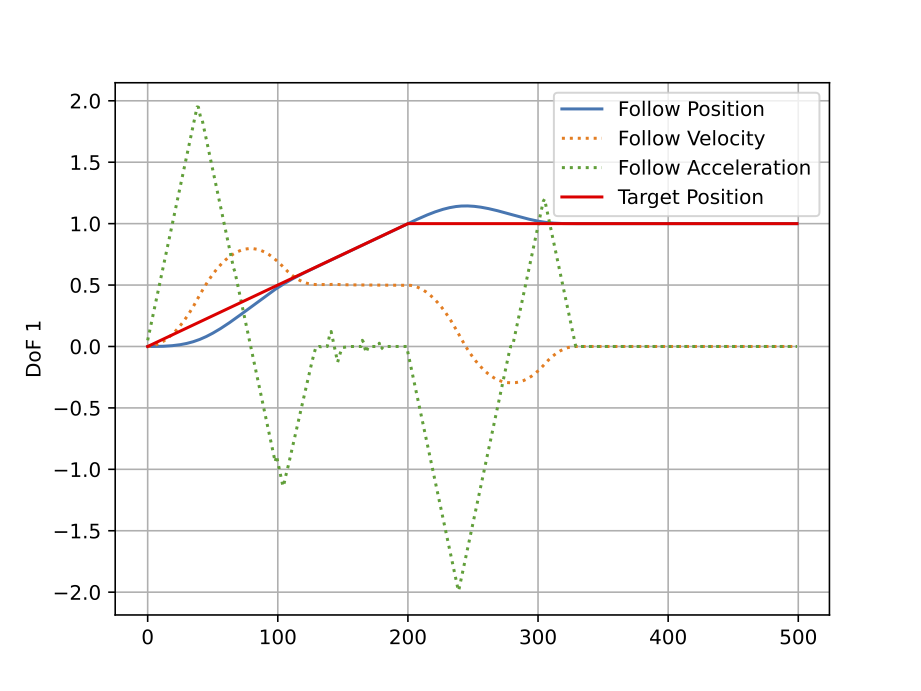
(14) Tracking
  • C++
    // Only with Ruckig Pro
    #include <cmath>
    #include "plotter.hpp"
    using namespace ruckig;
    // Create the target state signal
    TargetState<1> model_ramp(double t, double ramp_vel=0.5, double ramp_pos=1.0) {
    const bool on_ramp = t < ramp_pos / std::abs(ramp_vel);
    target.position[0] = on_ramp ? t * ramp_vel : ramp_pos;
    target.velocity[0] = on_ramp ? ramp_vel : 0.0;
    target.acceleration[0] = 0.0;
    return target;
    }
    TargetState<1> model_constant_acceleration(double t, double ramp_acc=0.05) {
    target.position[0] = t * t * ramp_acc;
    target.velocity[0] = t * ramp_acc;
    target.acceleration[0] = ramp_acc;
    return target;
    }
    TargetState<1> model_sinus(double t, double ramp_vel=0.4) {
    target.position[0] = std::sin(ramp_vel * t);
    target.velocity[0] = ramp_vel * std::cos(ramp_vel * t);
    target.acceleration[0] = -ramp_vel * ramp_vel * std::sin(ramp_vel * t);
    return target;
    }
    int main() {
    // Create instances: the Trackig trajectory generator as well as input and output parameters
    Trackig<1> trackig(0.01); // control cycle
    // Set input parameters
    input.current_position = {0.0};
    input.current_velocity = {0.0};
    input.current_acceleration = {0.0};
    input.max_velocity = {0.8};
    input.max_acceleration = {2.0};
    input.max_jerk = {5.0};
    // Optional minimum and maximum position
    input.min_position = {-2.5};
    input.max_position = {2.5};
    trackig.mode = TrackigMode::Optimized; // Optimized or Fast
    trackig.reactiveness = 1.0; // default value, should be in [0, 1]
    // Generate the trajectory following the target state
    std::cout << "target | follow" << std::endl;
    for (size_t t = 0; t < 500; t += 1) {
    const TargetState<1> target_state = model_ramp(trackig.delta_time * t);
    const Result res = trackig.update(target_state, input, output);
    std::cout << pretty_print(target_state.position) << " | " << pretty_print(output.new_position) << std::endl;
    output.pass_to_input(input);
    }
    }
    Input of the Ruckig algorithm.
    Definition input_parameter.hpp:66
    CustomVector< double, DOFs > current_acceleration
    Definition input_parameter.hpp:194
    CustomVector< double, DOFs > current_velocity
    Definition input_parameter.hpp:194
    CustomVector< double, DOFs > max_velocity
    Velocity limit.
    Definition input_parameter.hpp:200
    CustomVector< double, DOFs > current_position
    Current (start) state.
    Definition input_parameter.hpp:194
    CustomVector< double, DOFs > max_jerk
    Jerk limit.
    Definition input_parameter.hpp:206
    CustomVector< double, DOFs > min_position
    Minimum positional limit (only in Ruckig Pro).
    Definition input_parameter.hpp:212
    CustomVector< double, DOFs > max_position
    Maximum positional limit (only in Ruckig Pro).
    Definition input_parameter.hpp:209
    CustomVector< double, DOFs > max_acceleration
    Acceleration limit.
    Definition input_parameter.hpp:203
    Output of the Ruckig algorithm.
    Definition output_parameter.hpp:18
    CustomVector< double, DOFs > new_position
    New position values at the given time.
    Definition output_parameter.hpp:38
    void pass_to_input(InputParameter< DOFs, CustomVector > &input) const
    Copies the new output state to the current state of the input.
    Definition output_parameter.hpp:129
    The kinematic target state for Trackig.
    Definition trackig.hpp:40
    CustomVector< double, DOFs > acceleration
    Definition trackig.hpp:46
    The main interface for the Trackig algorithm.
    Definition trackig.hpp:91
    Definition block.hpp:17
    Result
    Result type of methods calculating trajectories (e.g. Ruckig's and Trackig's update and calculate).
    Definition result.hpp:7
    @ Optimized
    Optimized for tracking quality (Default).
    Definition trackig.hpp:33
  • Python
    # Only with Ruckig Pro
    from math import sin, cos
    from ruckig import Trackig, TrackigMode, TargetState, InputParameter, OutputParameter
    # Create the target state signal
    def model_ramp(t, ramp_vel=0.5, ramp_pos=1.0):
    target = TargetState(1)
    on_ramp = t < ramp_pos / abs(ramp_vel)
    target.position = [t * ramp_vel] if on_ramp else [ramp_pos]
    target.velocity = [ramp_vel] if on_ramp else [0.0]
    target.acceleration = [0.0]
    return target
    def model_constant_acceleration(t, ramp_acc=0.05):
    target = TargetState(1)
    target.position = [t * t * ramp_acc]
    target.velocity = [t * ramp_acc]
    target.acceleration = [ramp_acc]
    return target
    def model_sinus(t, ramp_vel=0.4):
    target = TargetState(1)
    target.position = [sin(ramp_vel * t)]
    target.velocity = [ramp_vel * cos(ramp_vel * t)]
    target.acceleration = [-ramp_vel * ramp_vel * sin(ramp_vel * t)]
    return target
    if __name__ == '__main__':
    # Create instances: Trackig as well as input and output parameters
    inp = InputParameter(1)
    out = OutputParameter(inp.degrees_of_freedom)
    trackig = Trackig(inp.degrees_of_freedom, 0.01)
    # Set input parameters
    inp.current_position = [0.0]
    inp.current_velocity = [0.0]
    inp.current_acceleration = [0.0]
    inp.max_velocity = [0.8]
    inp.max_acceleration = [2.0]
    inp.max_jerk = [5.0]
    # Optional minimum and maximum position
    inp.min_position = [-2.5]
    inp.max_position = [2.5]
    trackig.mode = TrackigMode.Optimized # Optimized or Fast
    trackig.reactiveness = 1.0 # default value, should be in [0, 1]
    print('target | follow')
    # Generate the trajectory following the target state
    steps, target_list, follow_list = [], [], []
    for t in range(500):
    target_state = model_ramp(trackig.delta_time * t)
    steps.append(t)
    res = trackig.update(target_state, inp, out)
    out.pass_to_input(inp)
    print(
    '\t'.join([f'{p:0.3f}' for p in target_state.position] + [f'{p:0.3f}' for p in out.new_position]),
    f'in {out.calculation_duration:0.2f} [µs]',
    )
    target_list.append([target_state.position, target_state.velocity, target_state.acceleration])
    follow_list.append([out.new_position, out.new_velocity, out.new_acceleration])

    # Plot the trajectory
    # from pathlib import Path
    # examples_path = Path(__file__).parent.absolute()
    # import numpy as np
    # import matplotlib.pyplot as plt
    # follow_list = np.array(follow_list)
    # target_list = np.array(target_list)
    # plt.ylabel(f'DoF 1')
    # plt.plot(steps, follow_list[:, 0], label='Follow Position')
    # plt.plot(steps, follow_list[:, 1], label='Follow Velocity', linestyle='dotted')
    # plt.plot(steps, follow_list[:, 2], label='Follow Acceleration', linestyle='dotted')
    # plt.plot(steps, target_list[:, 0], color='r', label='Target Position')
    # plt.grid(True)
    # plt.legend()
    # plt.savefig(examples_path / '14_trajectory.pdf')

Output Trajectory